







 6개월 연속 하락, 인플레 물가정점 통과', '.https://nimage.g-enews.com/phpwas/restmb_allidxmake.php?idx=5&simg=20221009064034006314a01bf698f12113525033.jpg');)
 6개월 연속 하락, 인플레 물가정점 통과', '.https://nimage.g-enews.com/phpwas/restmb_allidxmake.php?idx=5&simg=20221009064034006314a01bf698f12113525033.jpg');)
 6개월 연속 하락, 인플레 물가정점 통과', '.https://nimage.g-enews.com/phpwas/restmb_allidxmake.php?idx=5&simg=20221009064034006314a01bf698f12113525033.jpg');)




가격인상 라면 과자 가공식품 원가상승은 거짓말?
 이미지 확대보기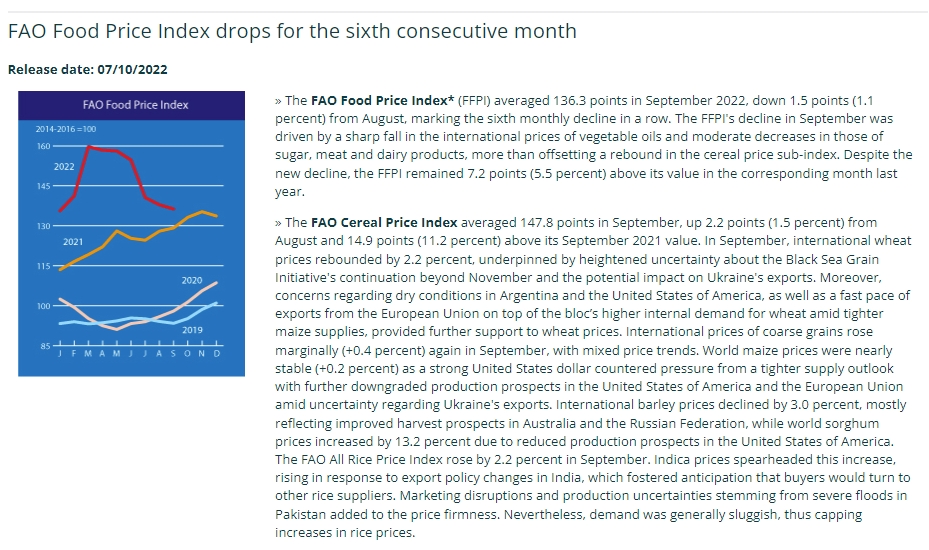
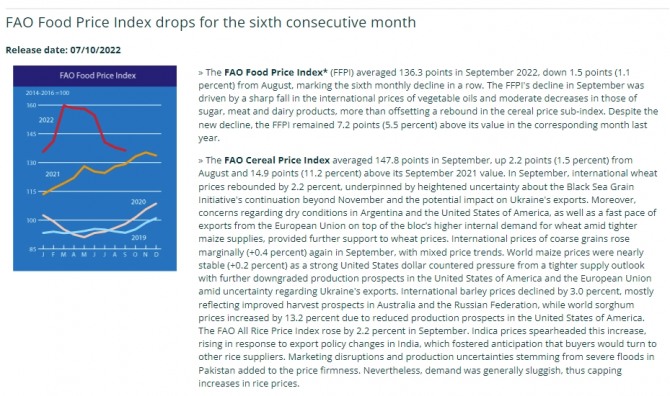
9일 뉴욕증시에 따르면 유엔 식량농업기구(FAO)는 9월 세계식량가격지수가 전월 대비 1.1% 내린 136.3을 기록했다고 밝혔다. 세계식량가격지수는 우크라이나 전쟁 발발 직후인 올 3월 역대 최고치인 159.7까지 올라갔다가 4월 158.4, 5월 158.1, 6월 154.7, 7월 140.7, 8월 137.9에 이어 6개월 연속 하락했다. FAO는 이와함께 8월 세계식량가격지수를 138.0에서 137.9로 수정했다. 러시아의 우크라이나 침공으로 급등했던 세계 식량 가격이 6개월 연속 하락하면서 물가 공포가 상당부문 사르라 들고 있다. 전년 동기 대비로는 5.5% 오른 상태이다.
FAO는 1996년 이후 24개 품목에 대한 국제가격 동향을 모니터링해 곡물·유지류·육류·유제품·설탕 등 5개 품목군별로 식량가격지수를 매월 집계해 발표하고 있다. FAO는 특히 식물성 기름 가격이 전월 대비 6.6% 급락하며 전체적인 식량 가격 하락을 주도했다고 밝혔다. FAO는 공급량 증가와 원유 가격 하락이 식물성 기름 가격을 떨어뜨리는 요인으로 작용했다고 설명했다. 설탕, 유제품, 육류 가격도 하락하면서 세계식량가격지수 하방 요인으로 작용했다. 곡물 가격지수는 전월 대비 1.5% 상승했다. 러시아의 군 동원령과 우크라이나 4개 점령지 합병 서명 등 전쟁 긴장 고조에 따라 우크라이나 곡물 수급의 불확실성이 커지면서 밀 가격이 2.2% 오른 데 따른 것으로 보인다. 쌀 가격도 최근 파키스탄에서 발생한 대홍수 여파로 전월 대비 2.2% 상승했다. FAO는 올 세계 곡물 생산량 전망치를 기존의 27억4천400만t에서 27억6천800만t으로 하향 조정했다. 이는 전년 대비 1.7% 감소한 규모다.
다음은 FAO 세계식량가격지수 (FFPI) 발표문
FAO Food Price Index drops for the sixth consecutive month
» The FAO Food Price Index* (FFPI) averaged 136.3 points in September 2022, down 1.5 points (1.1 percent) from August, marking the sixth monthly decline in a row. The FFPI's decline in September was driven by a sharp fall in the international prices of vegetable oils and moderate decreases in those of sugar, meat and dairy products, more than offsetting a rebound in the cereal price sub-index. Despite the new decline, the FFPI remained 7.2 points (5.5 percent) above its value in the corresponding month last year.
» The FAO Cereal Price Index averaged 147.8 points in September, up 2.2 points (1.5 percent) from August and 14.9 points (11.2 percent) above its September 2021 value. In September, international wheat prices rebounded by 2.2 percent, underpinned by heightened uncertainty about the Black Sea Grain Initiative's continuation beyond November and the potential impact on Ukraine's exports. Moreover, concerns regarding dry conditions in Argentina and the United States of America, as well as a fast pace of exports from the European Union on top of the bloc’s higher internal demand for wheat amid tighter maize supplies, provided further support to wheat prices. International prices of coarse grains rose marginally (+0.4 percent) again in September, with mixed price trends. World maize prices were nearly stable (+0.2 percent) as a strong United States dollar countered pressure from a tighter supply outlook with further downgraded production prospects in the United States of America and the European Union amid uncertainty regarding Ukraine's exports. International barley prices declined by 3.0 percent, mostly reflecting improved harvest prospects in Australia and the Russian Federation, while world sorghum prices increased by 13.2 percent due to reduced production prospects in the United States of America. The FAO All Rice Price Index rose by 2.2 percent in September. Indica prices spearheaded this increase, rising in response to export policy changes in India, which fostered anticipation that buyers would turn to other rice suppliers. Marketing disruptions and production uncertainties stemming from severe floods in Pakistan added to the price firmness. Nevertheless, demand was generally sluggish, thus capping increases in rice prices.
» The FAO Vegetable Oil Price Index averaged 152.6 points in September, down 10.8 points (6.6 percent) month-on-month, marking the lowest level since February 2021. The continued drop of the index reflected lower prices across palm, soy, sunflower and rapeseed oils. In September, international palm oil prices declined for the sixth consecutive month, largely driven by lingering heavy inventories that coincided with seasonally rising production in Southeast Asia. In the meantime, world soyoil quotations dropped moderately after a short-lived rebound in August in response to elevated export availabilities in Argentina, owing to sharply higher farmer sales. As for sunflower oil, international prices declined to a 14-month low due to increased export supplies from the Black Sea region amid subdued import demand. World rapeseed oil prices also fell markedly, primarily due to prospective abundant global production in the 2022/23 season. Lower crude oil prices also contributed to the downward pressure on world vegetable oil prices.
» The FAO Meat Price Index* averaged 121.4 points in September, down 0.6 points (0.5 percent) from August, also registering the third consecutive monthly decline, but still 8.7 points (7.7 percent) above its value in the corresponding month last year. In September, international price quotations for ovine meat declined the most, underpinned by the impacts of currency movements. Bovine meat prices also fell on high export availabilities from Brazil and elevated cattle liquidation in some producing countries. Meanwhile, poultry meat prices fell marginally as world import purchases remained subdued, notwithstanding constrained export supplies from some large exporting countries amid avian influenza outbreaks. By contrast, world pig meat prices increased further, reflecting the supply shortfall of slaughter-ready pigs in the European Union.
» The FAO Sugar Price Index averaged 109.7 points in September, down 0.8 points (0.7 percent) from August, marking the fifth consecutive monthly decline and reaching its lowest level since July 2021. The September decline was mostly related to the good production prospects in Brazil, the world's largest sugar exporter, with rains benefiting yields of standing crops and lower ethanol prices prompting a greater use of sugarcane to produce sugar. The weakening of the Brazilian real against the United States dollar exerted further downward pressure on world sugar prices while encouraging greater exports. Although the favourable production outlook for the 2022/23 season contributed to lowering prices, prevailing overall tight global sugar supplies limited the month-on-month price decline.
* Unlike for other commodity groups, most prices utilized in the calculation of the FAO Meat Price Index are not available when the FAO Food Price Index is computed and published; therefore, the value of the Meat Price Index for the most recent months is derived from a mixture of projected and observed prices. This can, at times, require significant revisions in the final value of the FAO Meat Price Index which could in turn influence the value of the FAO Food Price Index.
김대호 글로벌이코노믹 연구소장 tiger8280@g-enews.com