






;)
;)




 이미지 확대보기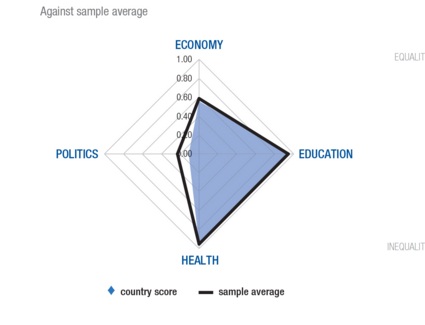
캄보디아 네팔보다 뒤져 있는 것으로 나타났다.
세계경제포럼 즉 WEF는 19일 '2015년 세계 성차별 보고서'를 발표했다.
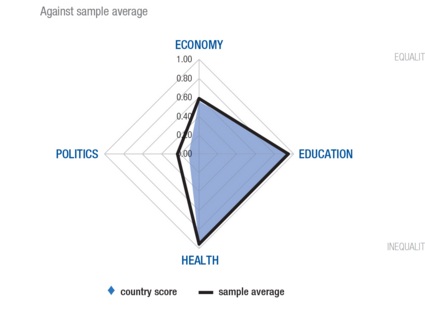
이 보고서에 따르면 한국은 남녀 간의 평등도 순위가 115위다.
가장 높은 점수는 1점(평등)이며 가장 낮은 점수는 0점(불평등)이다.
캄보디아, 네팔보다 낮다.
항목별로 보면 한국은 임금 평등 항목의 상위인 '경제활동 참여와 기회' 부문에서는 125위였다.
교육 부문에서는 102위였다.
정치참여부문 평등도는 101위였다.
이를 모두 감안한 종합 순위는 평가 대상 145개국 가운데 115위다.
종합1위는 아이슬란드로 0.881점이었다.
이어 노르웨이와 핀란드, 스웨덴, 아일랜드 등의 순이다.
일본은 101위다.
사우디와 200명의 난민이 입국한 시리아보다는 높다.
Global Gender Gap Index 2015. The highest possible score is 1 (equality) and the lowest possible score is 0 (inequality)
Rank Economy Score
1 Iceland 0.881
2 Norway 0.850
3 Finland 0.850
4 Sweden 0.823
5 Ireland 0.807
6 Rwanda 0.794
7 Philippines 0.790
8 Switzerland 0.785
9 Slovenia 0.784
10 New Zealand 0.782
11 Germany 0.779
12 Nicaragua 0.776
13 Netherlands 0.776
14 Denmark 0.767
15 France 0.761
16 Namibia 0.760
17 South Africa 0.759
18 United Kingdom 0.758
19 Belgium 0.753
20 Latvia 0.752
21 Estonia 0.749
22 Bolivia 0.749
23 Burundi 0.748
24 Barbados 0.744
25 Spain 0.742
26 Moldova 0.742
27 Mozambique 0.741
28 United States 0.740
29 Cuba 0.740
30 Canada 0.740
31 Lithuania 0.740
32 Luxembourg 0.738
33 Ecuador 0.738
34 Belarus 0.734
35 Argentina 0.734
36 Australia 0.733
37 Austria 0.733
38 Costa Rica 0.732
39 Portugal 0.731
40 Bahamas 0.728
41 Italy 0.726
42 Colombia 0.725
43 Bulgaria 0.722
44 Panama 0.722
45 Serbia 0.720
46 Trinidad and Tobago 0.720
47 Kazakhstan 0.719
48 Kenya 0.719
49 Tanzania 0.718
50 Cape Verde 0.717
51 Poland 0.715
52 Lao PDR 0.713
53 Israel 0.712
54 Singapore 0.711
55 Botswana 0.710
56 Mongolia 0.709
57 Zimbabwe 0.709
58 Uganda 0.708
59 Croatia 0.708
60 Thailand 0.706
61 Lesotho 0.706
62 El Salvador 0.706
63 Ghana 0.704
64 Bangladesh 0.704
65 Jamaica 0.703
66 Guyana 0.702
67 Ukraine 0.702
68 Malawi 0.701
69 Macedonia, FYR 0.701
70 Albania 0.701
71 Mexico 0.699
72 Senegal 0.698
73 Chile 0.698
75 Russian Federation 0.694
76 Kyrgyz Republic 0.693
77 Romania 0.693
78 Venezuela 0.691
79 Montenegro 0.689
80 Honduras 0.688
81 Czech Republic 0.687
82 Georgia 0.687
83 Vietnam 0.687
84 Sri Lanka 0.686
85 Brazil 0.686
86 Dominican Republic 0.686
87 Greece 0.685
88 Brunei Darussalam 0.684
89 Peru 0.683
90 Cameroon* 0.682
91 China 0.682
92 Indonesia 0.681
93 Uruguay 0.679
94 Suriname 0.678
95 Tajikistan 0.675
96 Azerbaijan 0.675
97 Slovak Republic 0.675
98 Gambia, The* 0.674
99 Hungary 0.672
100 Cyprus 0.671
101 Japan 0.670
102 Swaziland 0.670
103 Belize 0.668
104 Malta 0.668
105 Armenia 0.668
106 Guatemala 0.667
107 Paraguay 0.666
108 India 0.664
109 Cambodia 0.662
110 Nepal 0.658
111 Malaysia 0.655
112 Liberia 0.652
113 Maldives 0.652
114 Burkina Faso 0.651
115 Korea, Rep. 0.651
116 Zambia 0.650
117 Kuwait 0.646
118 Bhutan 0.646
119 United Arab Emirates 0.646
120 Mauritius 0.646
121 Fiji 0.645
122 Qatar 0.645
123 Bahrain 0.644
124 Ethiopia 0.640
125 Nigeria 0.638
126 Angola 0.637
127 Tunisia 0.634
128 Algeria 0.632
129 Benin* 0.625
130 Turkey 0.624
131 Guinea 0.618
132 Mauritania 0.613
133 Cote d’Ivoire 0.606
134 Saudi Arabia 0.605
135 Oman 0.604
136 Egypt 0.599
137 Mali 0.599
138 Lebanon 0.598
139 Morocco 0.593
140 Jordan 0.593
141 Iran, Islamic Rep. 0.580
142 Chad 0.580
143 Syria 0.568
144 Pakistan 0.559
145 Yemen 0.484
he Global Gender Gap Index was first introduced by the World Economic Forum in 2006 as a framework for capturing the magnitude of gender-based disparities and tracking their progress. This year is the 10th edition of the Index, allowing for time-series analysis on the changing patterns of gender equality around the world and comparisons between and within countries.
The Index benchmarks national gender gaps on economic, political, education and health criteria, and provides country rankings that allow for effective comparisons across regions and income groups. The rankings are designed to create greater awareness among a global audience of the challenges posed by gender gaps and the opportunities created by reducing them. The methodology and quantitative analysis behind the rankings are intended to serve as a basis for designing effective measures for reducing gender gaps.
The first part of this chapter reviews the underlying concepts employed in creating the Global Gender Gap Index and outlines the methods used to calculate it. The second part presents the 2015 rankings, global patterns, regional performance and notable country cases. This includes an analysis on country performance over time, particularly for those countries that have been included in the Index since 2006. Next, we provide information on the key trends that can be observed through a decade of data for the 109 countries that have been covered since the first Index, by analysing data along subindex, income and regional lines. The fourth part of this chapter lays out the economic case for gender equality, including links between gender gaps and the economic performance of countries. In the fifth and final part, we provide information on implications for public policy and business practices.
The Country Profiles contained in Part 2 of this Report give a more detailed picture of the relative strengths and weaknesses of each country’s performance compared with that of other nations and relative to its own past performance. The first page of each profile contains key demographic and economic indicators as well as detailed information on the country’s performance in 2015, including a comparison within its income group. The second page of the Country Profiles shows the trends between 2006 and 2015 on the overall Index and four subindexes, as well as over 55 gender-related indicators that provide a fuller context for the country’s performance. These indicators include information on employment & leadership; education and technology; health; family; and rights and norms.
김윤식 기자 tiger8280@